
Grant County Wanted List Status
Grant County has no official most-wanted gallery to browse. The Grant County Sheriff's Office runs the county's law enforcement site, but its menus hold no roster of wanted names, booking photos, physical descriptions, or the alleged offense tied to each person. Nothing public fills that gap. So any list you stumble onto claiming to be official deserves a hard second look.
One service comes close, though. Grant County Crime Stoppers gathers tips on felony crimes. It is not a directory of everyone deputies are hunting, and its P3 channel will not tell you whether a warrant is active. The county jail roster shows who is in custody after booking. Even so, it misses people wanted, people arrested elsewhere, and people already released.
Verify Grant County Warrants
A verified public warrant-search portal for Grant County does not exist. Indiana MyCase can pull up docket entries tied to a criminal case, yet a docket only tells you what was filed. Judges recall and resolve orders, and the online record may lag or run thin. Warrant status is best confirmed by pairing the court record with a call to the issuing court, an attorney, or the Sheriff.
If you believe a warrant names you, handle it the legal way. Aggregators are not final proof. Social posts count for even less. The Sheriff's Patrol Division is the unit whose deputies actually serve warrants, and the Grant County courts page steers visitors toward local court information.
- Search MyCase by name and limit results to Grant County criminal or citation matters. Compare identifying details carefully.
- Read the chronological case summary for entries related to an order or warrant, but treat it as case history rather than live confirmation.
- Contact an attorney or issuing court for a lawful response. The Sheriff's main line can route an appropriate office question.
- Call 911 for immediate danger. Never approach, follow, photograph, threaten, or attempt to arrest another person.
Grant County Wanted Tips
Crime Stoppers gives Grant County one clear tip line. It runs around the clock at 765-662-TIPS (8477), and tips can also go through the web-based P3 system. Callers may stay anonymous. The program offers a reward of up to $2,500 for information that leads to an arrest or indictment on felony charges, though only direct anonymous callers qualify under its terms.
Grant County Crime StoppersAnonymous tip line: 765-662-TIPS (8477)
Availability: 24 hours
Online option: P3 web tips
Emergency danger: 911
That reward is conditional, never automatic. Crime Stoppers also is not dispatch, a court, or a warrant desk, and it has nothing to do with the jail roster. For non-emergency police help, Grant Central Dispatch answers at 765-668-8168. Routine business with the Sheriff's Office goes through 765-662-9836. The official Crime Stoppers page lays out the county's full tip setup:
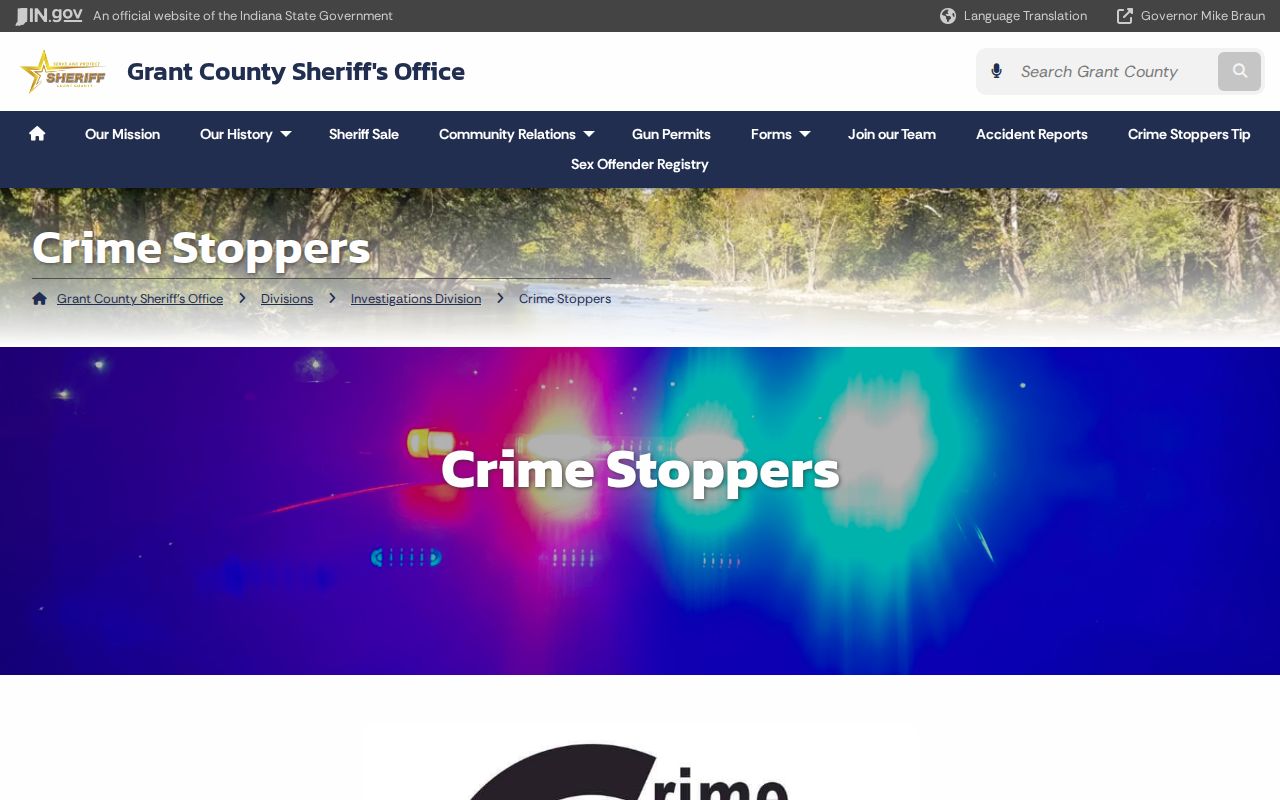
That page owns the current phone numbers, anonymity terms, and reward language. It exists for safe reporting, not for browsing wanted photos.
Grant County Wanted Channel Boundaries
Grant County spreads its public information across several tools. Each has a narrow job. None of them stands in for the missing wanted database. Learning what each one actually does keeps a custody alert, a social media post, or an anonymous tip from being read as proof of a live warrant.
| Channel | What it does | What it cannot prove |
|---|---|---|
| Sheriff and Patrol | Agency contact and warrant service | No public master list is posted |
| Crime Stoppers / P3 | Accepts nonurgent felony information | Does not certify warrant status |
| MyCase and Clerk | Case history and official court copies | An entry may not show live service status |
| VINE / SAVIN | Custody-status notices | No guilt, disposition, or wanted status |
| Sheriff social accounts | Selected agency announcements | Not complete arrest or warrant feeds |
No Sheriff-approved mobile app turned up for the county. Instead, the official pages point visitors toward Facebook, Instagram, Indiana SAVIN, and P3. Be careful with any app sporting a similar county name. Unless the Sheriff claims it and the developer checks out, treat it as unverified.
After a Grant County Arrest
After deputies book someone into Grant County Jail, custody can show up in the official current-inmate gateway. The table there is alphabetical and plain text. You get name, age, gender, height, and weight. But no booking photo, charge, bond, arresting agency, warrant detail, or release history appears.
Custody and court outcome are separate matters. A person can drop off the roster after bond, release, or transfer while their case moves forward. Treat the jail view as a snapshot of who is held now. Then turn to MyCase and the Grant County Clerk for filings, amendments, orders, and the disposition, which is simply the court's recorded result. The roster may list adults arrested by Marion, Gas City, Upland, the Sheriff, or another agency. A row alone does not show where the arrest happened. Local angles sit on the Marion Busted Mugshots, Gas City Busted Mugshots, and Upland Busted Mugshots pages.
Grant County Custody Alerts
Custody-change alerts come through VINELink and Indiana SAVIN for participating agencies. The Jail Division lists the Indiana number as 1-866-959-8463. Sign-up takes a phone number or email plus a confidential PIN, and repeat calls may follow a status change. A SAVIN notice helps once someone is in custody. It is not a wanted alert, though. It delivers neither a disposition nor a booking photo. The Sheriff's own instructions warn against leaning on a single notification service. For urgent safety worries, call 911 and follow a personal safety plan instead of waiting on an automated message.
Grant County Wanted Record Sources
Different questions belong to different custodians. The Sheriff handles agency routing and jail custody questions. A specific warrant concern goes to the issuing court or a lawyer. Need an official case copy? Ask the Clerk. And when you have felony information worth passing along, send it to Crime Stoppers rather than confronting anyone yourself.
- Warrant
- A court order authorizing a specified law-enforcement action.
- Booking
- The jail intake process after an arrest is accepted for detention.
- Disposition
- The recorded court result, such as dismissal, plea, acquittal, or judgment.
- Custody alert
- A notice about custody status, not a warrant check.
The Grant County Sheriff's Office runs its administration from 214 E. 4th Street in Marion, IN 46953. Call 765-662-9836 for the main line. Administrative hours run weekdays from 8:00 a.m. to 4:00 p.m., so anyone mailing paperwork should first confirm the right office and court. Worth noting: the county has no separate public warrant unit or records phone line.
One caution before treating any name as wanted. People share names, orders get modified, and private databases sit stale for months. Only the issuing office can confirm a record's current status.
Reading Grant County Wanted Claims
A solid wanted notice can be traced back to the agency that put it out. The Sheriff's name should be on it. So should a date, a plain statement of why the person is wanted, and a way to reach the office directly. That matters a lot when a search result just recycles an old social post or shows a booking photo with no date attached. Photos can linger online long after a warrant has been cleared or a person has been released.
There is no verified public master list of wanted individuals for Grant County. So treat every field with skepticism. A photo, a last-known location, a physical description, a charge, or a reward figure on some online profile may not have come from the Sheriff at all. Look at whatever source the post names. If it points only to another private database, it never reached an official record.
Matching a name to a person takes real care. Two people can share a name and an age. Details from the county arrest roster can help separate records, but they are not enough on their own. Cause numbers, court dates, and the jurisdiction that issued the warrant carry more weight. Still unsure? Call the office that holds the record instead of spreading a name or photo around.
A dated Sheriff social media post can be cited for what it actually says, nothing more. It is a selective announcement. It skips plenty of outstanding warrants, and it should not be read as current forever. See whether the agency posted a follow-up, then verify through the court or the Sheriff directly. Local news that repeats a release deserves the same caution.
Good conduct does not depend on the source. Never go to a listed address. Do not follow someone's movements or post an unverified location online. Urgent tips belong with 911, and eligible nonurgent felony information goes to Crime Stoppers. If you think you have your own warrant, work through a lawyer and the issuing court rather than trying to dodge service.